Gul e Sahar, CEO of Digitec, shares why her team left enterprise AI to build YeongSil — a voice companion for the elderly, blind, and visually impaired. 2,400+ waitlist.
FOUNDER STORY · YEONGSIL
Three years ago, we were processing 10TB of data daily for enterprise clients. Today we're building a small pentagon-shaped device that reads letters out loud to people who can't see. This is why.
The Feedback We Couldn't Ignore
In three years of building AI systems for enterprise clients at Digitec, the feedback was always the same. The AI was good. The results were measurable. But nobody wanted to open another browser tab to use it.
Our analysts, operations managers, and small business owners didn't want a dashboard. They wanted to ask a question out loud and get an answer — the way you'd ask a colleague sitting next to you.
We kept building better AI. The interface problem kept following us.
Then a client said something I haven't stopped thinking about: “This is brilliant. My father would never use it.”
His father is 74. He has low vision. He's never owned a smartphone. And every tool we'd built — every beautiful dashboard, every intelligent assistant — was invisible to him.
That sentence is why YeongSil exists.
“This is brilliant. My father would never use it.” — The feedback that changed everything.
The People Technology Left Behind
There are 2.2 billion people worldwide living with vision impairment, according to the World Health Organization. There are 1.4 billion people aged 60 and over globally today, and by 2050 that number is projected to reach 2.1 billion. Eighty-five percent of visually impaired people live in low- and middle-income countries. In Pakistan alone, there are more than 8.2 million people living with disabilities, with visual impairment as the leading category.
Now look at the tools those people have access to. Smart speaker penetration in Pakistan is under 2%. Average smartphone complexity has increased year over year since 2019 — more gestures, smaller icons, more nested menus, more permissions dialogs. Every major AI breakthrough of the last five years has assumed a user who can type, tap, swipe, and read a screen.
ChatGPT requires typing. Smart speakers don't know who you are or what documents matter to you. Tablets need constant updates and passwords. The gap between what AI can technically do and what an elderly or visually impaired person can actually access has never been wider than it is right now.
This is the market nobody was serving. It is also the market we decided to build for.
A Companion, Not a Product
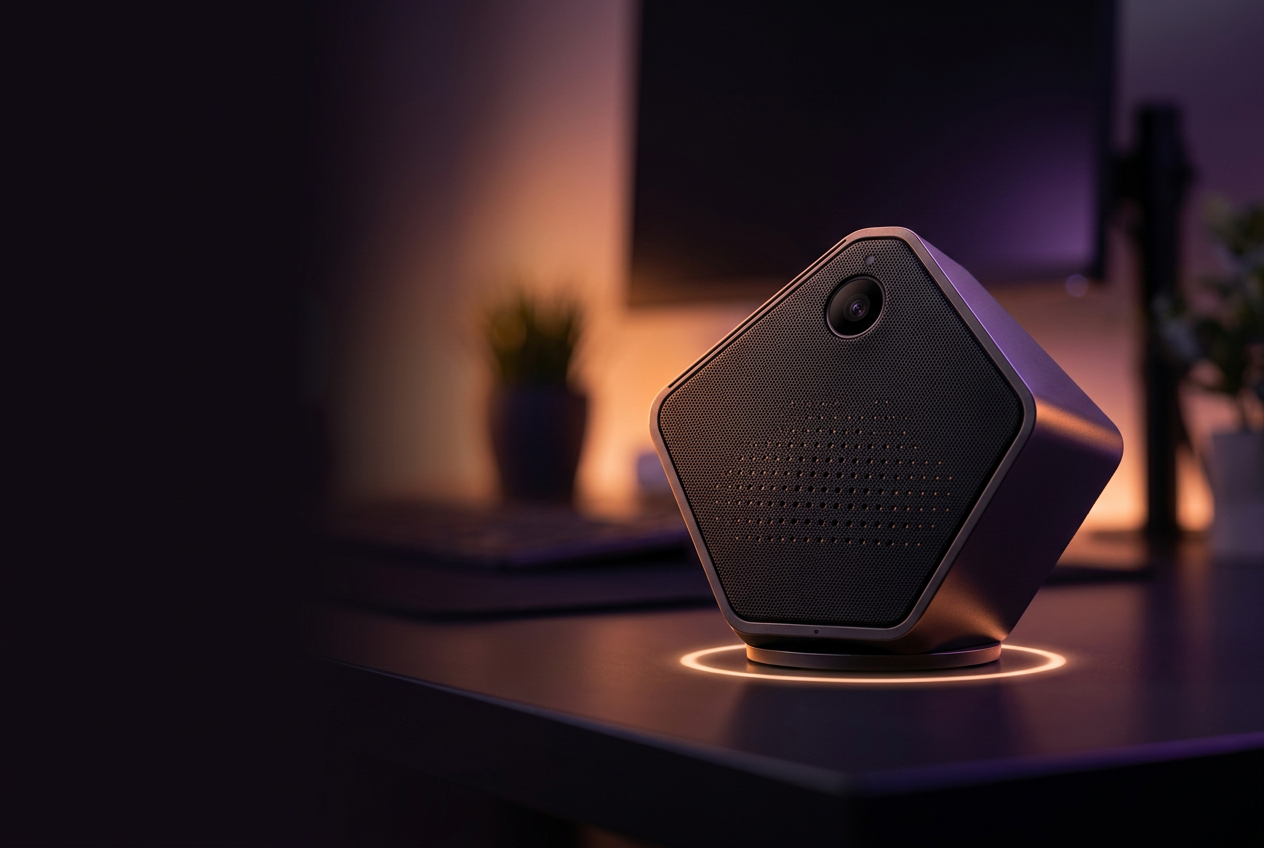
YeongSil is a small pentagon-shaped device. It sits on a desk or a kitchen counter. You talk to it. It talks back. There is no phone, no screen, no app, and no buttons. If you can speak, you can use it. The device is named Sil.
Sil reads letters, prescriptions, and bills out loud. It sees through its camera — describing what's in front of it, reading labels, and recognising the people who walk into the room. It calls family members, sends messages, and sets reminders. It remembers your documents: upload a folder once, and you can ask questions about it forever. It knows your life — not just the internet. Smart home control follows in 2027, adding lights, thermostats, and locks through Matter and Thread.
Here is what that actually looks like in a home.
Imagine your mother is 78. She lives alone. She received a letter from her doctor two weeks ago and has been too embarrassed to ask you to read it to her again.
With Sil, she says: “Read me the letter from the hospital.” Sil finds it and reads it out loud, clearly, at whatever pace she needs.
She asks: “Should I be worried about this?” Sil explains what the letter means in plain language.
She says: “Book me an appointment.” Sil calls the clinic.
She didn't need to touch a phone. She didn't need to squint at a screen. She didn't need to wait for you to visit. That is what independence looks like.
Want to see how YeongSil could serve the people you care about?
Join the YeongSil waitlistNo phone. No screen. No buttons. If you can speak, you can use YeongSil.
Why Digitec Is the Right Team to Build This
Digitec Solution was founded in Lahore, Pakistan. We are PSEB-registered. Over the last three years we have shipped more than 150 AI and data projects for 40+ enterprise clients, and we process in excess of 10TB of data every day across the pipelines we run in production.
The team has built retrieval-augmented generation systems, document processing pipelines, computer-vision models, and agentic workflows for enterprise clients in fintech, healthcare, e-commerce, and B2B SaaS. YeongSil is directly downstream of that work. It uses the same RAG architecture, the same document indexing, and the same vision pipelines — repackaged and hardened for an individual person instead of a compliance-heavy enterprise deployment. This is not a team that wandered into AI hardware. It is a team that has been building the core technology for three years.
I am often asked: why Pakistan? The honest answer is that Pakistan is one of the best-kept secrets in AI hardware development. We graduate 25,000 computer science engineers every year. Lahore has a dense cluster of ML and embedded-systems talent. Our manufacturing cost structure makes a sub-$500 retail BOM tractable. And we have none of the visa friction that constrains comparable teams in Eastern Europe or South Asia.
The same structural advantage that allowed ARM to build chips from Cambridge in the 1990s exists in Lahore today. The market is not pricing it.
A $1.1 Trillion Market That AI Has Never Properly Served
The global elder care and assistive device market was valued at $868.2B in 2024 and is projected to reach $1.1T by 2029 at a compound annual growth rate of 5.8%. AI assistive technology is the fastest-growing sub-segment within that broader category. And yet — for all the money and talent pouring into consumer AI — the device landscape for this market has a large, obvious gap.
- Amazon Echo: knows your home, not your life.
- ChatGPT: brilliant, requires a screen and typing.
- Rabbit R1: tried to replace the phone, discontinued.
- Humane AI Pin: tried to replace the phone, discontinued.
- Net result: nobody currently owns the personal AI device category.
YeongSil's differentiated position is deliberate. Document memory — indexed personal files — is a moat that gets deeper with every upload. A camera and vision stack means Sil sees the world rather than only listening to it. The device is LLM-agnostic, so it survives model migrations rather than being locked to one vendor's roadmap. It is privacy-first: user data never trains a model. And it was designed voice-first from day one, not retrofitted from a screen-first product.
The window before Apple, Amazon, or Google properly addresses the accessible, document-aware AI device category is the 18 months between now and end-2027. Apple is constrained by Siri's legacy architecture. Amazon is constrained by Echo's cost model and Prime upsell logic. Google is constrained by its search business.
None of them have built for elderly users. None of them have built for the visually impaired. None of them have document memory. The market is large, underserved, and uncontested.
Where We Are Today
2023
Digitec founded. Enterprise AI and data services. First major client. First 10TB/day data pipeline.
2024
150+ projects shipped. 40+ enterprise clients. Decision made to build YeongSil. Core document memory and vision architecture designed.
Early 2025
Web prototype built and tested. Accessibility pivot confirmed — elderly and visually impaired as the primary market. First waitlist signups: organic only, zero paid ads.
Late 2025
Full product specification locked. Hardware BOM finalised on the Raspberry Pi 5 platform. YeongSil OS design begun.
2026
yeongsil.digitecsolution.com launched. 2,400+ waitlist signups — zero paid acquisition. Pricing validated: $4.99/mo and $14.99/mo Pro. Product Hunt listing live. Developer platform announced (SDK opens 2027, 70% revenue share). Digitec Foundation Programme announced for NGO and accessibility partnerships.
2027 (target)
Hardware ships. Mobile companion app launches on iOS and Android. Smart home integration lands via Matter/Thread. SDK opens to developers.
How YeongSil Makes Money
1. Hardware (one-time)
Retail price TBA. The BOM on the Raspberry Pi 5 platform is tractable at a sub-$500 retail margin. Every device sold creates a subscription customer.
2. Subscription (recurring, high-margin)
- $4.99/mo — BYOLLM (Bring Your Own LLM key). Platform access, document uploads up to 1GB, camera and voice pipeline, web search.
- $14.99/mo — Pro (full YeongSil experience). YeongSil native LLM (no external key needed), 10GB document uploads, autonomous mode, Skill Store access, priority support.
- Custom — Teams & Business. Hotels, retail, clinics. Multi-device, custom persona, API access, SLA guarantee. Priced per engagement.
3. Developer platform (revenue share)
Developers build “skills” — like apps for YeongSil. 70% revenue goes to the developer, 30% to YeongSil. Zero marginal cost. Opens 2027.
Unit economics note: at $14.99/mo Pro, the hardware pays back in under three years at retail margin. Subscription LTV is the real story. Developer revenue adds a third line at zero marginal cost.
What We're Actually Building
We are not building a smart speaker. We are not building an Alexa competitor. We are not trying to replace the phone.
We are building the interface layer for personal AI — a physical presence in the user's space that knows their documents, hears their voice, sees their world, and acts on their behalf.
The person who benefits most from this is not a 35-year-old tech professional who already has every tool. It is a 76-year-old woman in Lahore who received a medical letter she can't read, whose children live abroad, who doesn't want to feel like a burden.
It is a young man in Karachi who was born with low vision and has spent his whole life depending on other people to read the world for him.
It is a small shop owner in Faisalabad who has twelve years of invoices in a folder and no way to ask a question about any of them.
YeongSil is for them. And it is also for every person who simply wants an AI that knows their life — not just their last search query.
We are building from Lahore. We are building for the world.
We're Looking for the Right Partners
YeongSil ships in 2027. We are currently in the pre-order and partnership phase.
If you are an investor who sees the AI device category the way we do — underserved, wide open, and about to consolidate — we would like to talk.
If you are an NGO or accessibility organisation who wants to partner on making YeongSil available to the people who need it most, we have a dedicated foundation programme.
If you are a developer who wants to build skills on top of YeongSil and reach thousands of devices from day one, early access applications are open.
If you are a journalist or media professional who wants to tell this story, we have a full press kit ready.
We are raising our first external round. If YeongSil fits your thesis, the conversation starts here.
Contact: yeongsil@digitecsolution.com · Explore YeongSil: yeongsil.digitecsolution.com
Gul e Sahar — CEO, Digitec Solution · linkedin.com/in/gul-e-sahar
Frequently asked questions
What is YeongSil?
YeongSil is a small pentagon-shaped voice AI device built by Digitec Solution in Lahore, Pakistan. It has no screen, no app, and no buttons — you talk to it and it talks back. It reads documents out loud, sees through its camera to describe the world, calls family, and remembers your personal files so you can ask questions about them anytime. It is designed primarily for the elderly, blind, and visually impaired.
Who is YeongSil built for?
YeongSil is built for people who have been left behind by smartphones and chatbots — primarily elderly users, blind and visually impaired users, and anyone who prefers to interact with technology by speaking rather than typing or tapping. It is equally useful for anyone who wants a private AI that knows their documents and their home, not just the public internet.
When does YeongSil ship?
YeongSil ships in 2027. As of 2026 the product is in the pre-order and partnership phase, with 2,400+ people on the waitlist acquired entirely through organic channels. The mobile companion app, smart home integration via Matter/Thread, and developer SDK all launch alongside the hardware in 2027.
How much does YeongSil cost?
Hardware retail pricing is TBA and targets a sub-$500 BOM on the Raspberry Pi 5 platform. Subscription pricing is $4.99/month for BYOLLM (bring your own LLM key) and $14.99/month for Pro, which includes the YeongSil native LLM, 10GB document uploads, autonomous mode, and the Skill Store. Custom pricing is available for teams and business deployments.
Why is YeongSil being built in Pakistan?
Pakistan graduates 25,000 computer science engineers per year, and Lahore has a dense cluster of ML and embedded-systems talent. The manufacturing cost structure makes a sub-$500 retail BOM tractable, and the delivery model avoids the visa friction that constrains comparable teams in Eastern Europe or South Asia. Digitec Solution has shipped 150+ AI and data projects for 40+ enterprise clients, and YeongSil is the direct downstream product of that engineering base.
Is YeongSil open to investors and partners?
Yes. Digitec is currently in active conversations with investors, NGOs and accessibility organisations, developers interested in the Skill Store (70% developer revenue share), and media partners. Interested parties can contact yeongsil@digitecsolution.com or visit yeongsil.digitecsolution.com.
References & sources
- World report on vision — World Health Organization
- World Population Ageing 2023 — United Nations, Department of Economic and Social Affairs
- Persons with Disabilities in Pakistan — Population Census — Pakistan Bureau of Statistics
- Elder Care Services Market Size & Share Analysis — Mordor Intelligence
Pakistan's first AI device is being built now. Be part of it.
YeongSil ships in 2027. Whether you're an investor, an accessibility partner, a developer for the Skill Store, or a family looking to give a loved one their independence back — we'd love to hear from you.
Digitec Solution is an AI-first digital agency helping enterprises modernise legacy systems and ship intelligent products. Explore our work in AI & Machine Learning, Big Data, and Digital Transformation.

Founder and CEO of Digitec Solution. AI entrepreneur and design-led transformation leader helping enterprises craft intelligent, conversion-focused brand and product experiences.