

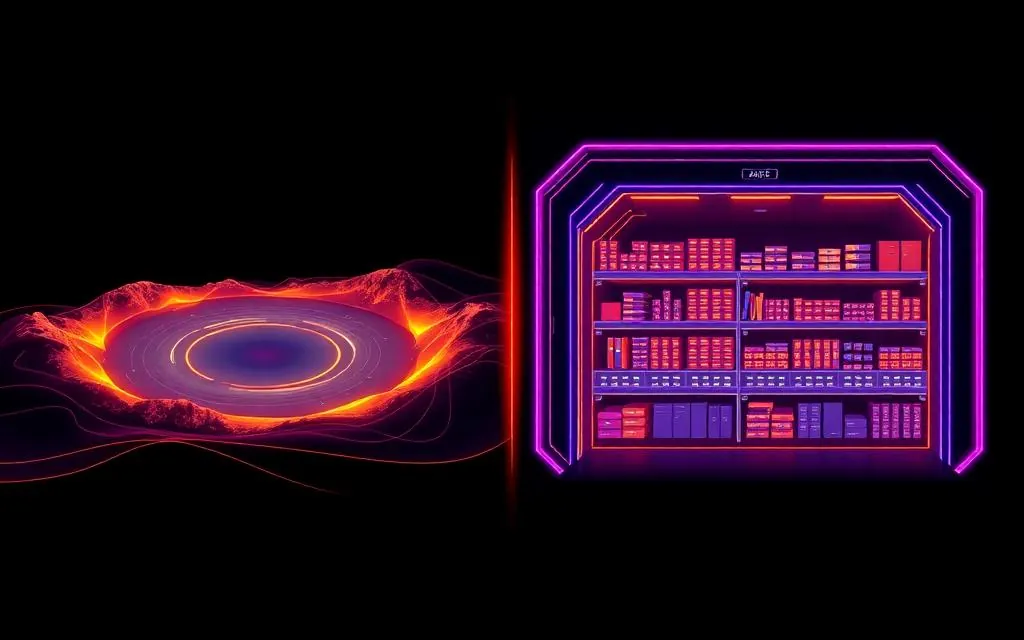
The data warehouse vs data lake debate is over. The new question — lakehouse vs cloud warehouse — actually matters because it determines how cheaply, flexibly and AI-readily your data scales for the next decade.
Quick Definitions Without the Jargon
A cloud data warehouse (Snowflake, BigQuery, Redshift) stores structured, well-modeled data optimized for SQL analytics and BI. A data lakehouse (Databricks, Microsoft Fabric, Snowflake's Iceberg tables) stores everything — structured and unstructured — in open table formats like Delta, Iceberg or Hudi, and supports analytics, ML and AI workloads in the same place.
Why Lakehouse Won the Last Three Years
- ML and AI workloads need raw and semi-structured data — warehouses don't store that natively.
- Open table formats (Iceberg, Delta) decouple storage from compute — no more vendor lock-in.
- Streaming and batch in the same architecture — no parallel pipelines.
- Lower storage costs at scale — object storage instead of proprietary formats.
- Direct AI/ML training on the same data BI is reading from — no copies, no drift.
When a Pure Warehouse Still Makes Sense
If your workloads are 95% SQL BI, your team is more analyst-heavy than engineer-heavy, and you don't expect serious ML/AI on top of the platform in the next 24 months, Snowflake (or BigQuery) as a pure warehouse is simpler, cheaper to run, and faster to be productive on. Don't overbuild.
Want an honest assessment of lakehouse vs warehouse for your stack?
Book a free data architecture reviewThe 2026 Reference Stack
- Ingestion: Fivetran, Airbyte, or native CDC tools.
- Storage: Iceberg or Delta on object storage (S3, ADLS, GCS).
- Compute: Databricks, Snowflake, or Fabric — interchangeable thanks to open formats.
- Transformation: dbt as the standard.
- Orchestration: Dagster, Airflow, or Prefect.
- BI: Power BI, Looker, Tableau, or Hex.
- ML/AI: MLflow, feature store, and a vector store sitting in the same lake.
- Governance: Unity Catalog or Microsoft Purview.
How to Choose Without Regret
Map your three-year workload mix. If >30% of your roadmap involves ML, AI agents, RAG over enterprise data, or unstructured-data processing, go lakehouse. If you're a BI-heavy organization with stable structured data, a modern warehouse like Snowflake will serve you for a decade with less complexity. And whichever you pick: insist on open table formats so you're never locked in.
Your data architecture in 2026 isn't just a BI decision. It's the decision that determines how AI-ready your business is in 2028.
References and sources
- Lakehouse: A New Generation of Open Platforms — Armbrust et al., CIDR 2021
- The Data Warehouse Toolkit (3rd Ed.) — Ralph Kimball, Wiley
- Building Real-Time Data Pipelines — Confluent / Apache Kafka
- Designing Data-Intensive Applications — Martin Kleppmann, O'Reilly
Next step
Build a data platform your AI deserves.
We architect, migrate and operate modern lakehouse and warehouse platforms — designed for analytics, AI, and the next decade of growth.